Perspective and the image making process.
To master drawing in perspective, you have to move through three distinct states of mind: the graphic, the spatial, and the mathematical. Here is how to bridge the gap between a loose sketch and a technical blueprint.
Phase 1: The Thinking Process
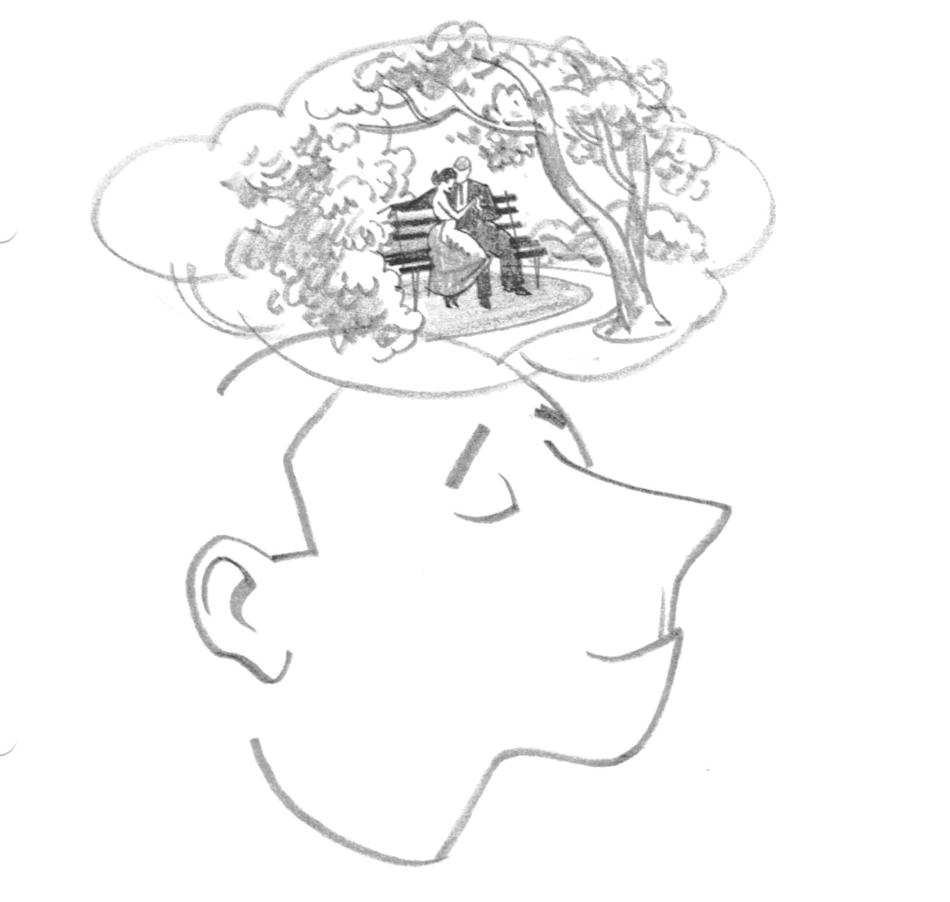
Famous Artists Schools. Famous Artists Course: Lesson 3, Composition. Famous Artists Schools Inc., 1960.
Before you pick up a ruler, you must think like a designer. Start with small rectangular boxes to explore theHierarchy of Shapes. A successful composition relies on the BMS (Big, Medium, Small) principle. Your most important elements should be the primary focus. Either placed near the center of the composition, scaled as the largest shapes, or given the highest level of contrast. Without this variation in size and importance, a drawing feels cluttered and lacks a clear narrative.
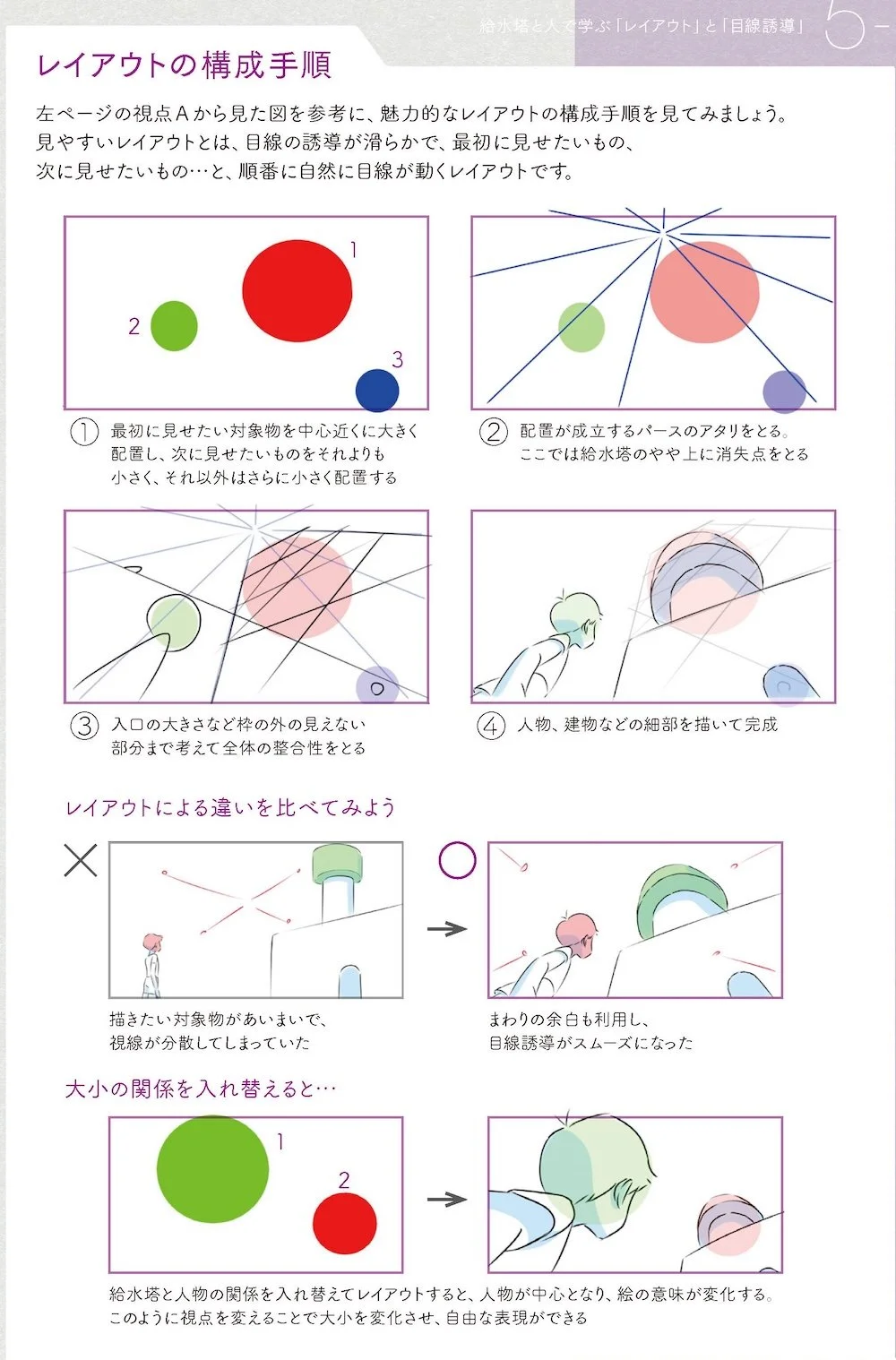
Muroi, Yasuo. Anime Shijuku-ryuu: Saisoku de Nandemo Egakeru You ni Naru Kyara Sakuga no Gijutsu [Anime Private School Style: Character Drawing Techniques to Become Able to Draw Anything as Fast as Possible]. X-Knowledge, 2017. https://amzn.to/4rlYAjB
Once the shapes are established, move into value studies using the Value Matrix by Bill Perkins. Rather than drawing lines or specific objects, you are designing a pattern of light and dark. Limit your composition to a maximum of three or four tones. Organize these into specific Value Key: High Key (mostly light), Mid Key (balanced), or Low Key (mostly dark).
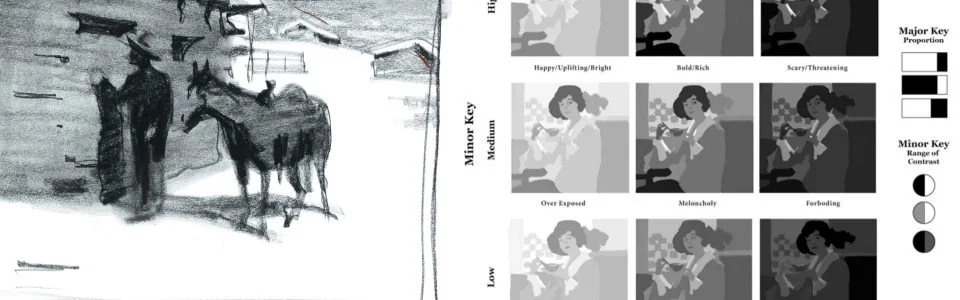
Perkins, B. (2023). Composition for the visual artist live class – current class recordings [Video]. New Masters Academy. https://www.nma.art/videolessons/composition-for-the-visual-artist-live-class-current-class-recordings/
By grouping your darks and lights together into large, clear masses, you create a high-impact, poster-like design. This "graphic" approach ensures the viewer’s eye is immediately pulled toward your focal point before any technical perspective is even applied.
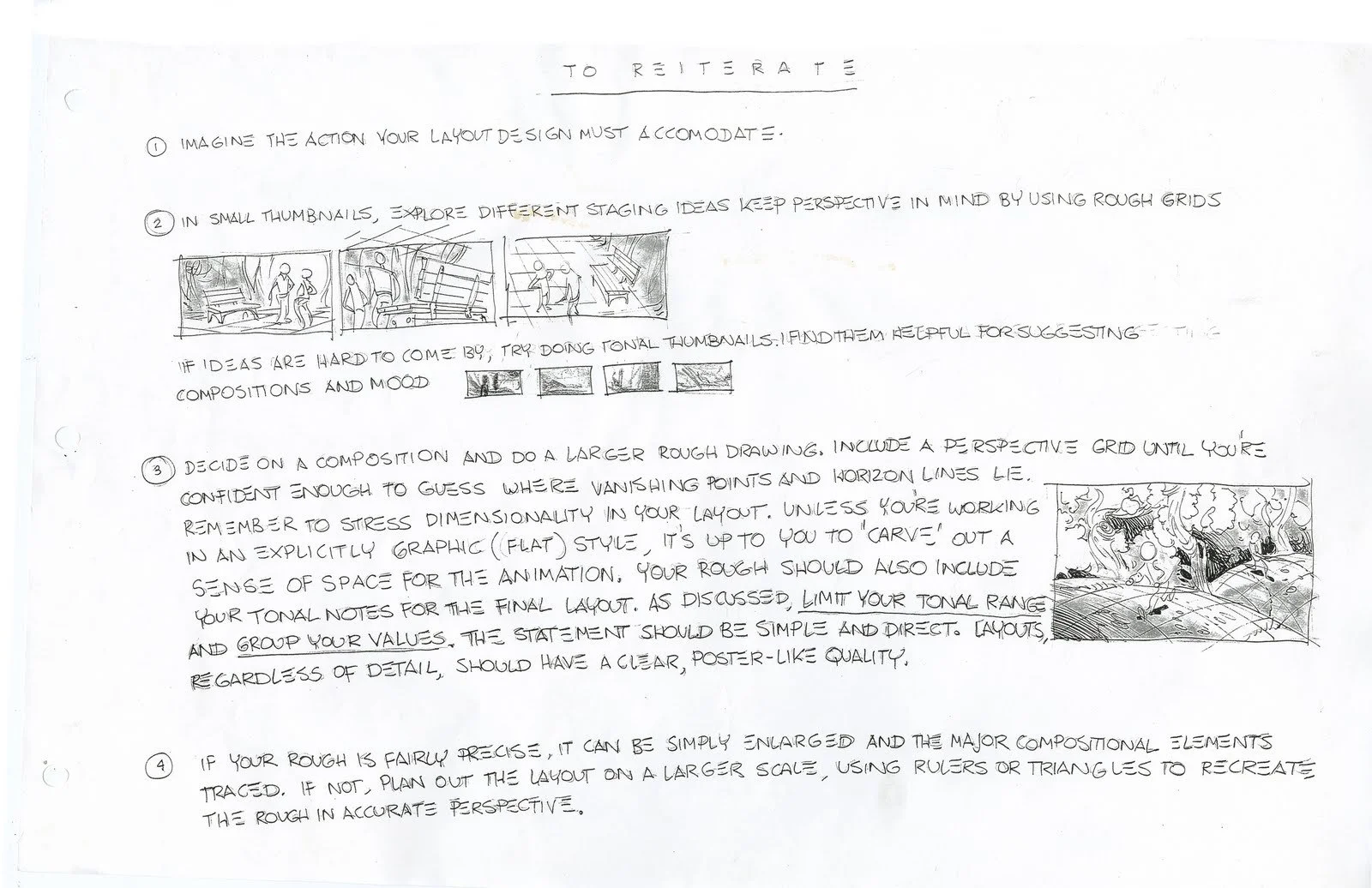
The Perfectly summarize Paul Felix image making process. Kennedy, Mark. "Paul Felix Layout Notes." Temple of the Seven Golden Camels, 30 Nov. 2011, sevencamels.blogspot.com/2011/11/paul-felix-layout-notes.html.
Phase 2: Defining the Viewer/ Camera
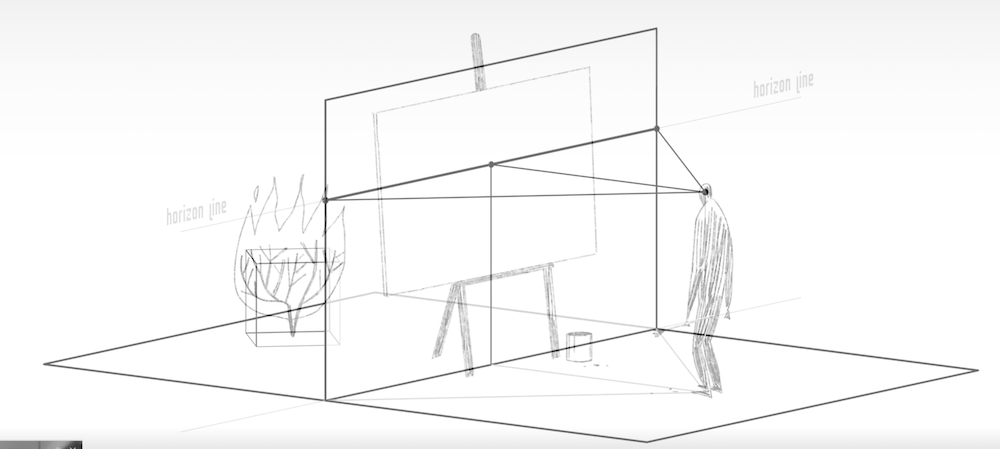
Kolesov, S. (2024). Space envelope: Dealing with perspective [Digital video and materials]. Gumroad. https://peleng.gumroad.com/l/SpaceEnvelope
Now you must define the physics of your "camera." Perspective is not about the object you are drawing; it is about where the artist is standing. The Station Point represents your eye's fixed position. If you stand too close to your subject, the drawing will appear distorted and warped.
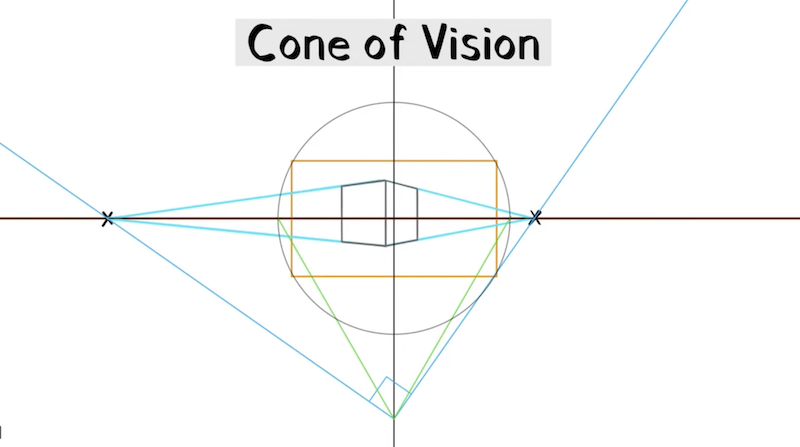
Whitehead, C. (2022, May 22). Vanishing points with the cone of vision [Video]. YouTube. https://www.youtube.com/watch?v=T-21p22lCQE.
To keep the drawing believable, stay within the Cone of Vision, which is a 60-degree field of view radiating from your eye. Any object placed outside this circle will look unnaturally stretched.
Phase 3: The Mathematical Framework
To find your vanishing points scientifically, use the 90-Degree Rule. Imagine a right angle at your Station Point. Where the sides of that angle hit the Horizon Line, that is where your Left and Right Vanishing Points are located. As you rotate your head, these points slide along the horizon, but they always maintain that 90-degree relationship to your eye.
You then use Measuring Points (found by rotating the distance from the vanishing point to the station point up to the horizon) to transfer those real-world measurements into deep space. If you want a box to be exactly 5 inches deep, the Measuring Point tells you exactly where to cut the line.
Phase 4: Constructing Volume
Every complex object, from a sports car to a human figure, starts as a simple box.
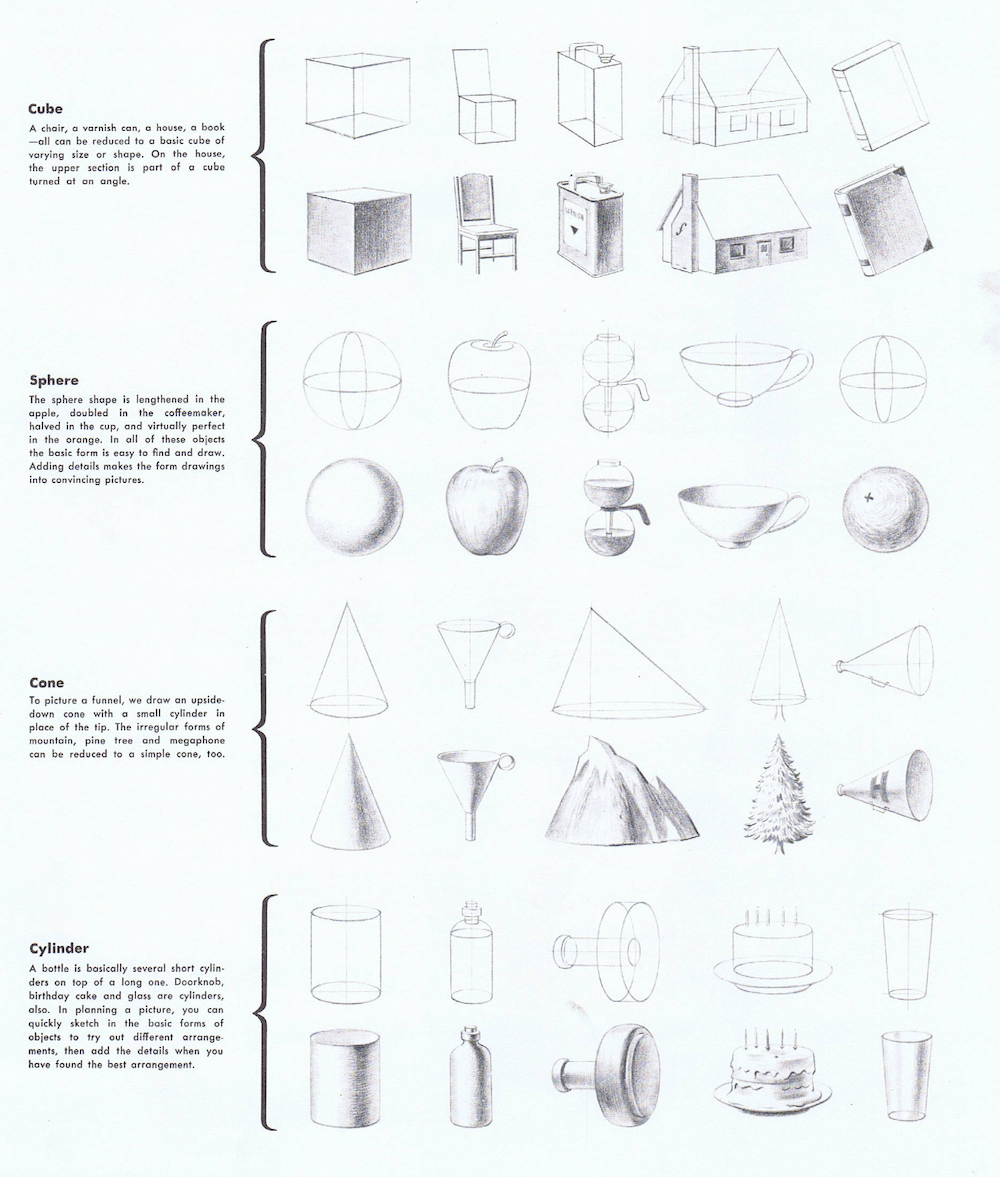
Famous Artists Schools. Famous Artists Course: Lesson 2, FORM. Famous Artists Schools Inc., 1960.
When drawing organic forms like trees or mountains, do not paint them as flat shapes. Build them as simple volumes like cylinders or spheres on your perspective grid first. This ensures they have weight and occupy real space.
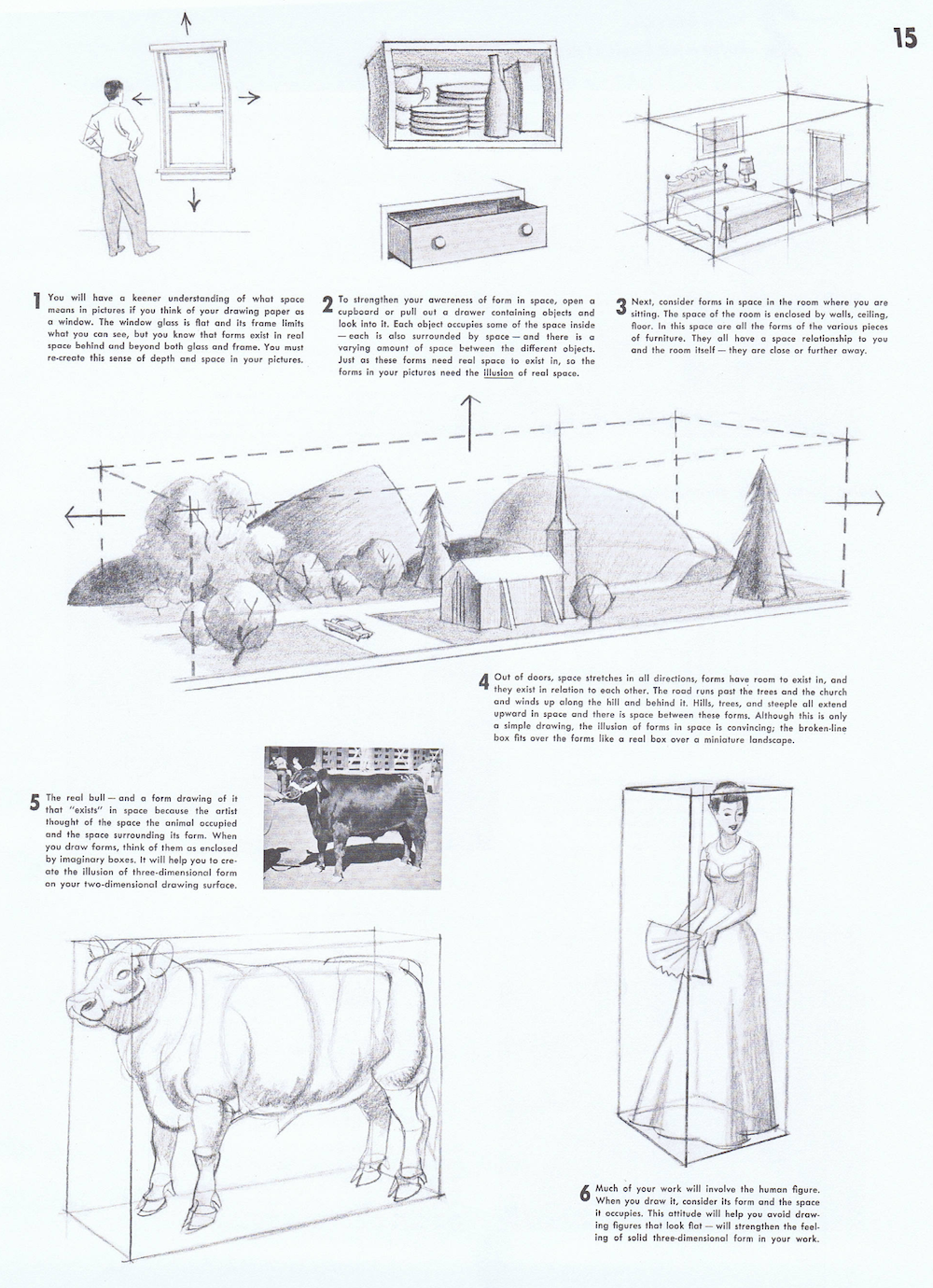
Famous Artists Schools. Famous Artists Course: Lesson 2, FORM. Famous Artists Schools Inc., 1960.
Phase 5: Light and Atmosphere
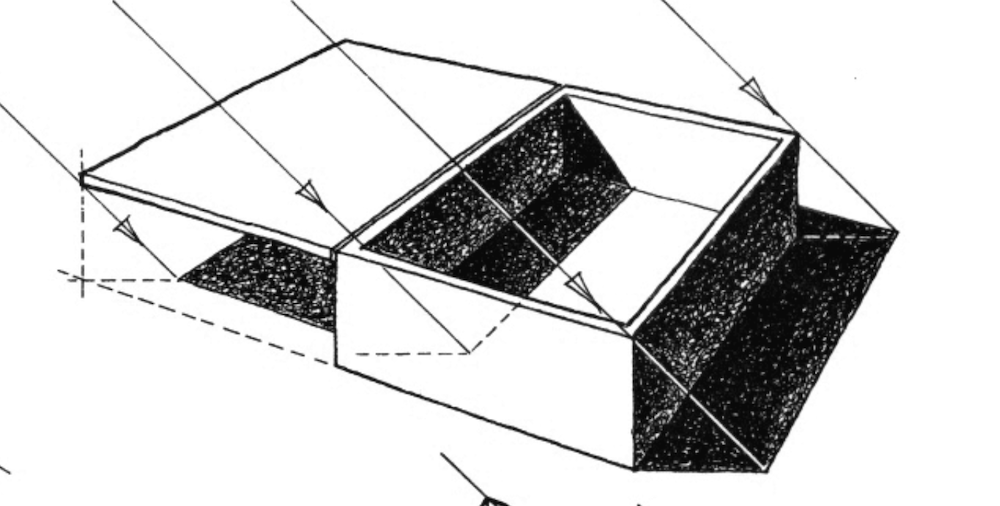
Finish the drawing by anchoring objects with light physics. For sunlight, shadows follow the standard vanishing points because sun rays are parallel. For artificial light like a lamp, you must drop a vertical line to the floor to find the specific vanishing point for that shadow.